
VR gaming has a reputation problem. Half the people who have never tried it assume they will be sick within five minutes. The other half assume it is only for teenagers with expensive kit. However, neither is really true any more. In short, this is an honest beginner’s guide, written for people who have never put a headset on and are not sure they want to.
What VR gaming actually is
Virtual reality replaces what your eyes see with a computer-generated world. You wear a headset with two small screens inside. Meanwhile, sensors track your head, so the view moves when you move.
That last part is the whole trick. Therefore, when you look left, the world stays put and you turn within it. Your brain accepts this surprisingly quickly, usually within about thirty seconds.
In addition, you hold a controller in your hands, which the game turns into whatever you are holding in that world. As a result, aiming, reaching and grabbing feel natural rather than learned.
The two kinds of VR gaming, and why the difference matters
Most beginners do not realise there are two quite different experiences sharing one name. Therefore, this is the single most useful thing to understand before you try it.
Home VR with a headset
Home VR means a standalone headset used in your living room. You stand or sit in a small space, roughly two metres square. Meanwhile, you move around the game world using a thumbstick rather than your legs.
It is convenient and it is cheap compared with a few years ago. However, that mismatch between moving in the game and standing still in real life is exactly what causes motion sickness in some people. In addition, you play alone, or with friends who are somewhere else entirely.
Free roam VR in an arena
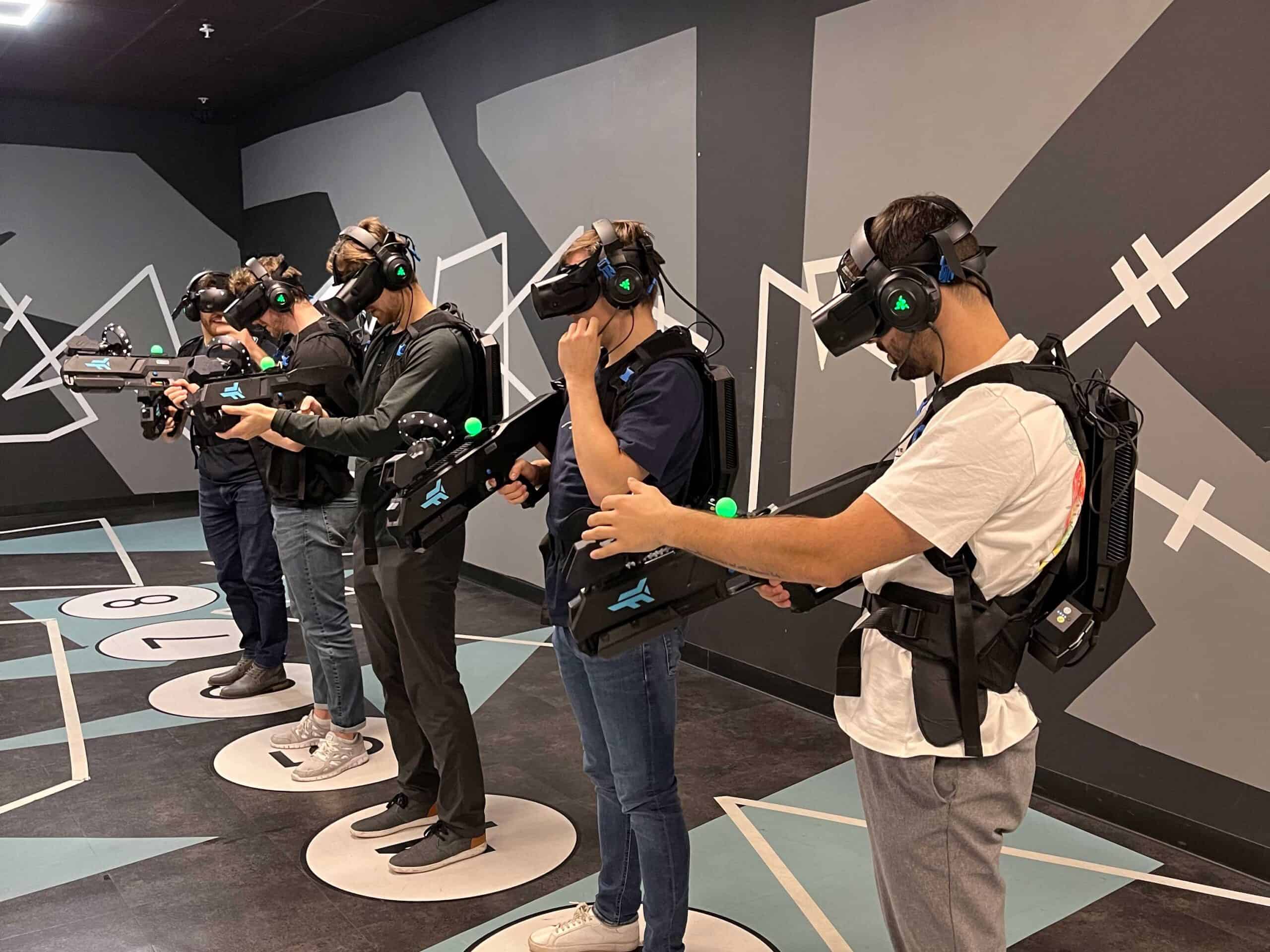
Free roam VR works differently. There are no wires connecting you to anything. Instead, you walk around a real, empty, warehouse-scale arena while the game builds a world around you.
Therefore, when you walk forward in the game, you are actually walking forward. Your legs and your eyes agree with each other. As a result, motion sickness becomes far less likely, because the mismatch that causes it has been removed.
In addition, free roam is social by design. Up to eight players share the same arena and the same virtual world at the same time. You see your friends as characters beside you. Meanwhile, you can talk to them normally, because they are genuinely standing two metres away.
What VR gaming actually feels like the first time
People usually expect it to feel like a very good television. It does not.
The first thing that surprises beginners is scale. When something is tall in VR, you feel that it is tall. Therefore, looking down from a height produces a real physical reaction, even though you know the floor is right there.
The second surprise is presence. Within a minute or two, most people stop thinking about the headset entirely. As a result, they duck, flinch and lean without being told to. In short, your body responds before your reasoning catches up.
Meanwhile, the third surprise is how quickly it stops being intimidating. Almost nobody needs more than a couple of minutes to get comfortable.
Will I feel sick? An honest answer
This is the question beginners actually care about, so it deserves a straight answer.
Motion sickness in VR is real. However, it is caused by a specific thing. Your inner ear says you are still, while your eyes say you are moving. Therefore, your brain treats the conflict as a warning sign.
As a result, the risk is highest in seated or standing home VR with thumbstick movement. Meanwhile, it is much lower in free roam VR, because you physically walk. The signals match, so the conflict never arises.
Practical ways to reduce the risk
- Eat something light beforehand. An empty stomach makes it worse, and so does a heavy meal.
- Skip the pre-session pint. At our arenas, anyone under the influence of alcohol is not allowed to play anyway.
- Get the headset fitted properly. A blurry image is a common hidden cause of discomfort.
- Say something early. Staff would far rather adjust things at minute two than minute twenty.
- Take the first minute slowly. Look around before you start moving quickly.
In addition, it is worth knowing that discomfort fades fast once the headset comes off. It is not like seasickness that lingers for hours.
Do I need to be good at video games?
No, and this is where VR gaming differs most from a console. Traditional games require you to learn a controller. Meanwhile, VR mostly requires you to move your body, which you already know how to do.
Therefore, groups with wildly different gaming experience tend to level out quickly. For example, a parent who has never held a controller will often outperform a teenager, simply because the parent is happy to move around properly.
In short, willingness matters more than skill.
What to expect from a session
Your first VR gaming session at an arena follows a fairly predictable shape.
- Arrive early. We recommend 15 minutes before your slot, because the briefing starts on time.
- Safety briefing. Staff explain how to play and help you put on the equipment.
- Kit up. The headset is adjusted until the picture is sharp and comfortable.
- Play. A free roam session gives you 30 minutes of gameplay inside the arena.
- Compare scores. Most groups spend as long arguing about the leaderboard afterwards.
Meanwhile, a member of staff runs the session from start to finish. Therefore, if anything needs adjusting, you only have to say so.
What to wear
Wear light, comfortable clothing, as if you were going for a long walk around the shops. However, trainers or flat shoes are much better than heels. In addition, hats cannot be worn during the game, and heavy make-up can smear on the lenses. Glasses are fine, although contact lenses are usually more comfortable under a headset.
Who VR gaming suits best
Free roam VR works particularly well for groups who need one plan that suits everyone. For example, mixed-age families, work teams, birthday groups, and stag and hen parties all fall into that category.
Free roam VR gaming also suits people who normally dislike gaming. Therefore, if someone in your group has already announced that this is not their sort of thing, they are frequently the one who enjoys it most.
Meanwhile, there are a few genuine limits. At our arenas, free roam games start at age 10 or 12 depending on the game, and our VR Quest Arena welcomes players from age 8. Under-14s need an adult present, although the adult does not have to play. In addition, people with epilepsy or similar seizure disorders cannot play, and VR is not recommended for anyone heavily pregnant or with a heart condition. Therefore, it is worth checking before you book for a large group.
Is it worth trying?
If your only reference point is a headset someone bought and then left in a cupboard, you have not really seen what the technology does. However, walking around a real arena with seven friends inside the same world is a different proposition entirely.
In short, VR gaming has moved past the novelty stage. It is now simply a good group activity that happens to use clever kit. As a result, the best way to judge it is to try it once, with people you like, rather than to read another opinion about it.
Our arenas in Nottingham, Birmingham, Manchester, Guildford and Reading run beginner-friendly sessions for up to eight players, with no experience needed. Explore our VR experiences and book your first session.
 The Best VR Experiences and Games for Kids